What parts of an antique chandelier can be restored?
Restoration covers a wide range of work, and very few chandeliers need all of it. Depending on the piece, restoration and repair may involve structural repairs to frames, branches and arms; straightening or stabilising damaged components; work to the suspension, chain and canopy; the replacement of missing or damaged crystals and glass; re-stringing and re-dressing; careful cleaning of the original glass; conservation of brass, bronze, ormolu and other metalwork; gilding or lacquer work where that is appropriate; and rewiring or electrification where it is necessary.
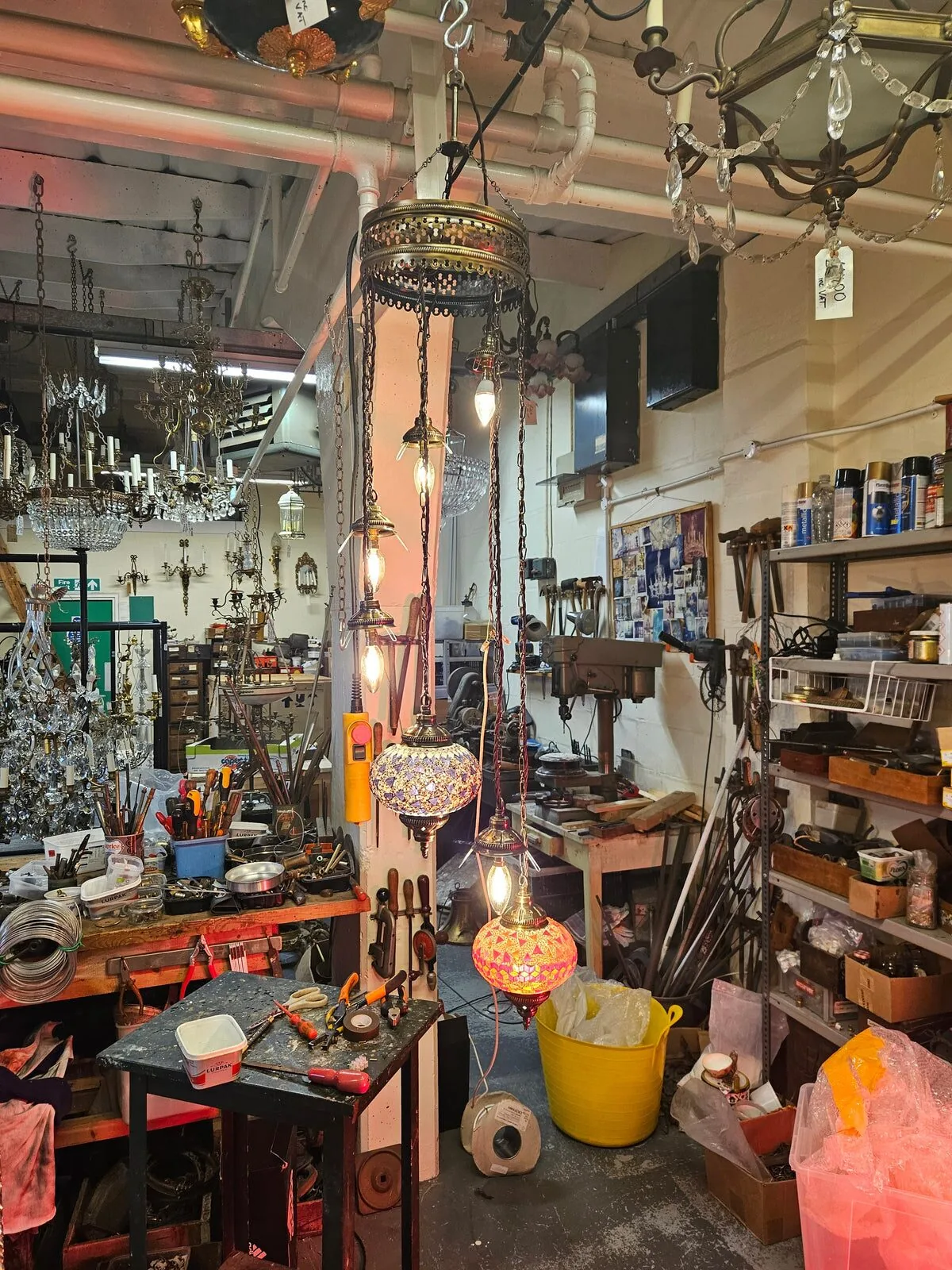
What matters is choosing only the treatments the individual chandelier actually requires. One fitting may need nothing beyond a thorough clean and a few replacement drops; another may need its frame stabilised, its glass re-dressed and its wiring renewed. Work is carried out either in situ or at our Hoddesdon, Hertfordshire workshop, depending on the piece and the extent of what is needed.
Does broken or missing glass mean the chandelier cannot be restored?
Usually not. In many cases missing or damaged glass can be replaced. We keep a stock of spare antique chandelier glass and can often source period-appropriate replacement components as well.
The aim is to find replacements that are sympathetic to the original chandelier, matching the character, form and colour of the surrounding glass, rather than making the piece look artificially new. Not every missing component can be matched exactly — unusual shapes, sizes and older glass can be difficult to find — and where a close match is not available we will say so before any work is agreed.
Should an antique chandelier be made to look new?
Usually no. There is an important difference between sympathetic restoration and over-restoration. Sympathetic work repairs what needs repairing and leaves the rest of the chandelier as it is. Over-restoration removes the evidence of the chandelier's own history.
Original finishes, construction and the patina that a fitting has acquired over many decades often form a genuine part of its character, and once removed they cannot be put back. Cleaning, conservation and repair should therefore suit the individual piece rather than automatically polishing, refinishing or replacing everything. On some chandeliers the right decision is to do less rather than more.
What happens when a chandelier is dismantled?
Where dismantling is required, components are removed methodically and documented and catalogued as they come off, so that every piece returns to its correct position on reassembly.
This matters particularly with dressed chandeliers, where the glass arrangement can differ throughout the fitting and apparently similar drops may vary subtly in size, shape or placement. One of the problems we are most often asked to put right is glass that has been reassembled differently from the way it was originally arranged after a chandelier has been taken down by others.
Can old wiring be replaced during restoration?
Yes. Old or unsafe wiring can usually be renewed as part of restoration while retaining the chandelier's appearance and original construction wherever that is practical. New cable is routed discreetly through the existing arms, columns and canopy, and lamp holders are chosen to suit the period of the fitting.
Perished insulation, cable that has been disturbed by past house moves, and fittings that have never been electrified at all are all common. This side of the work is covered in more detail on our chandelier rewiring and electrification page, and in whether an antique chandelier can be rewired safely.
Can damaged metalwork be repaired?
Frames, arms, branches and fittings can often be repaired, straightened, stabilised or conserved, depending on the metal involved and the nature of the damage. Brass, bronze, ormolu and other antique metalwork each behave differently, and the approach has to suit the material as much as the fault.
Not every kind of damage can be made invisible. Old metal that has been stressed, previously repaired or heavily corroded may need a more cautious approach, and in some cases the honest outcome is a repair that is sound and safe but still discernible on close inspection. A restored 19th-century brass fitting and a workshop restoration are both documented in our restoration of a decorative Turkish chandelier and the restoration of a Georgian hanging lantern.
When might restoration not be worthwhile?
Restoration is not always the right answer. The factors we weigh up include the extent of the damage, the structural condition of the piece, whether suitable replacement components are available, the historical importance of the chandelier, the cost of the work relative to the piece itself, and whether the intervention would remove important original material.
Where we think restoration may not be appropriate or worthwhile, we will say so. We would rather give an honest opinion than carry out work that does not serve the chandelier or its owner.
Should I have an antique chandelier assessed before restoration?
It is usually the sensible first step. Photographs are often enough for an initial discussion: the whole chandelier, the damaged areas, any missing glass or components, the frame and suspension, and the wiring or lamp holders where those are relevant. Approximate dimensions and your location are helpful too.
From that we can normally give a good idea of what the work would involve. Some pieces, particularly heavily damaged or complicated ones, need a workshop inspection before the full scope can be confirmed. There is no obligation, and we are always happy to offer advice.
We have worked with antique chandeliers and period lighting since 1954, as a family business now in its third generation. Examples of completed projects can be seen in our Recent Work, and further questions are answered in our Advice & Guides.
Chandelier Restoration & Repair — we work from our Hoddesdon, Hertfordshire workshop, serving Hertfordshire, London, the Home Counties and beyond.